
Summary:
Most people searching for back patio ideas aren’t looking for a design magazine spread. They want to know what will actually work in their yard, what it’s going to cost, and whether they can trust someone to build it right. That’s a reasonable set of questions — and the answers depend a lot on where you live. Mecklenburg County’s clay soil, humid summers, and occasional heavy rain make material choice and installation quality more important here than in a lot of other markets. This guide covers the most popular patio options, what drives the cost, and what separates a patio that lasts twenty years from one that starts shifting after the first wet winter.
Patio Ideas That Start With Your Actual Yard, Not a Pinterest Board
The best patio for your backyard isn’t necessarily the one that looks best in photos. It’s the one that fits your space, drains properly, holds up in the heat, and matches how you actually use your outdoor area. In Mecklenburg County, that means thinking about more than just aesthetics.
Clay soil expands when it’s wet and contracts when it dries out. That ground movement is the number one reason patios crack, shift, and settle prematurely — and it’s completely avoidable with the right base preparation. A well-built patio in this area starts with proper excavation, a compacted gravel base, and drainage that moves water away from the structure and your home’s foundation.
Once the foundation question is answered, the fun part starts: choosing your material, your layout, and the features that make the space worth spending time in.

Outdoor Patio Ideas: Designing a Space You'll Actually Use Year-Round
One of the real advantages of living in the Charlotte metro area is that your patio isn’t a seasonal investment. Mecklenburg County winters are mild enough — average January lows hover around 35°F — that a well-designed outdoor space with a fire pit or fireplace can be enjoyed ten or eleven months out of the year. That changes how you should think about the design.
A patio that’s purely a flat surface is a starting point, not a finished outdoor room. The spaces people actually use consistently tend to have some combination of shade for the summer months, warmth for the cooler ones, and defined zones for different activities — dining, lounging, cooking, gathering around a fire. July heat indexes in this area regularly push past 100°F, which means shade isn’t a luxury feature; it’s what makes the space usable during the hottest part of the year.
When we work with homeowners in Monroe, Waxhaw, Weddington, and the surrounding communities, the conversation almost always starts the same way: what do you want to do out here? The answer to that question shapes everything — the size, the material, the features, and the budget. A family that wants a space for weekend cookouts needs something different than a couple who wants a quiet spot for morning coffee. Neither is wrong. Both deserve a design that fits.
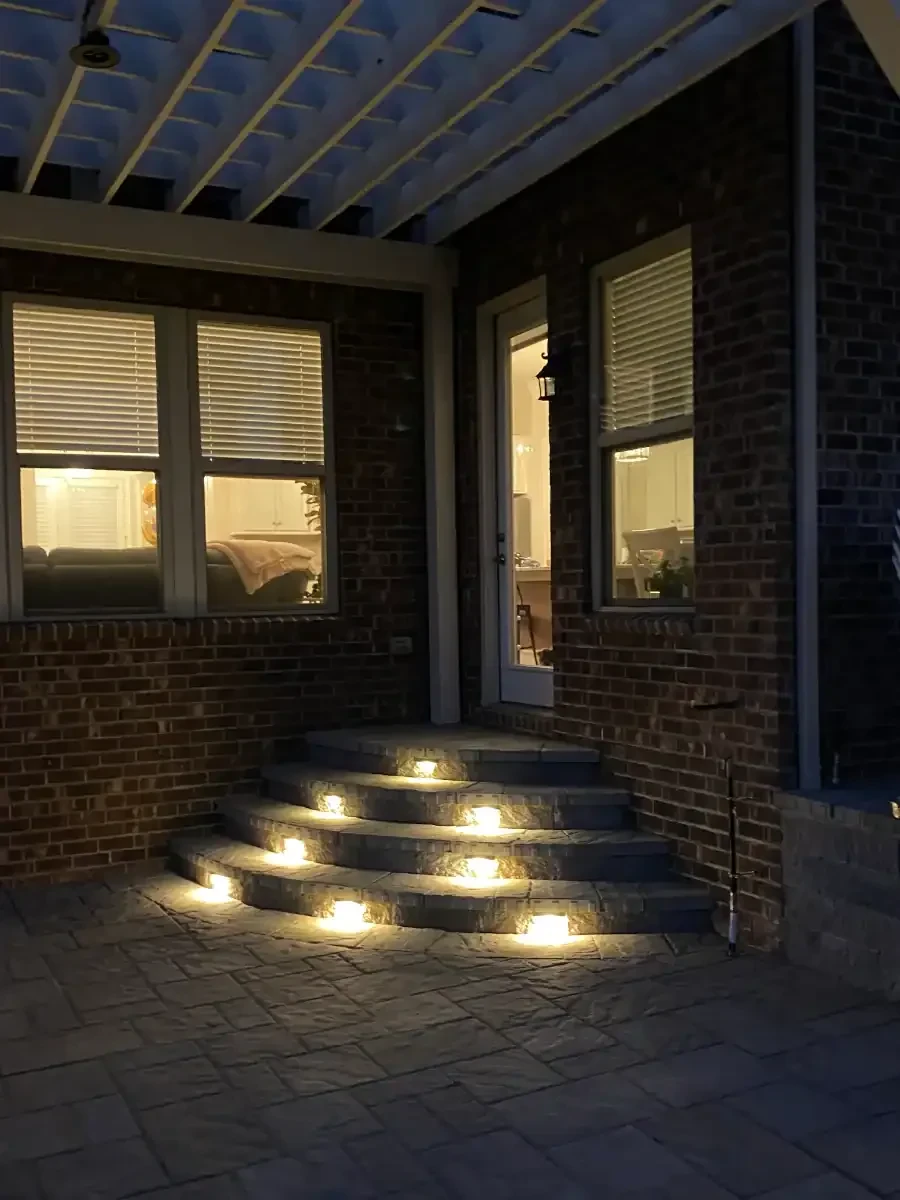
Outdoor patio ideas worth considering include covered structures like pergolas or solid-roof additions for shade, built-in seating walls that double as retaining elements on sloped yards, fire pits or outdoor fireplaces for cooler evenings, and outdoor kitchens for homeowners who entertain regularly. These aren’t upgrades for the sake of it — they’re features that extend how often and how comfortably you use the space.
Stone Patio Ideas: What Natural Stone Actually Looks Like After Five Years in NC
Natural stone patios — flagstone, bluestone, slate, travertine — have a character that manufactured materials can’t fully replicate. Each piece is slightly different, the color variation is organic, and a well-laid stone patio tends to look better as it ages rather than worse. That’s part of the appeal.
What people don’t always think about is how natural stone performs in North Carolina’s specific conditions. The Piedmont region gets real rainfall, and the clay soil underneath creates movement that cheaper or improperly installed stone work doesn’t handle well. Flagstone that’s dry-laid in sand needs to be set on a proper base, with pieces large and stable enough that they don’t rock underfoot after the ground shifts. Mortared stone requires even more attention to base preparation because mortar joints will crack if the foundation beneath them isn’t solid.
The upside of natural stone is that maintenance stays relatively simple over time. Most homeowners skip sealer to preserve the natural matte finish, and any stone that settles can be lifted and reset without disturbing the rest of the surface. That kind of repairability is genuinely useful in a climate where the ground moves seasonally.
Flagstone patio ideas work particularly well for homes with traditional or craftsman-style architecture, wooded lots where the organic texture fits the surroundings, and yards where a more formal paver pattern would feel out of place. The cost is higher than concrete or standard pavers — natural stone typically runs $15 to $30 per square foot installed — but the longevity and visual result often justify the difference. We source materials native to North Carolina wherever possible, which tends to produce better long-term performance because the stone is already acclimated to the regional climate and moisture levels.
Want live answers?
Connect with a Union Landscaping and Hardscape expert for fast, friendly support.
Concrete Patio Ideas for Mecklenburg County Homeowners Who Want Durability Without Sacrificing Style
Concrete gets a bad reputation it doesn’t always deserve. A plain gray slab poured without much thought is one version of a concrete patio. Stamped concrete with a cobblestone or wood-plank pattern, a decorative border, and a color wash is something else entirely — and it’s often half the cost of natural stone with a comparable visual result.
Concrete patios have a lifespan of 20 to 30 years when installed correctly, which is roughly double what you’d get from a wood deck at about half the price. For homeowners in Union County and the southern Mecklenburg corridor who want a durable, low-maintenance surface that holds up through hot summers and wet winters, poured or stamped concrete is one of the most practical options available.
The key word is “installed correctly.” In Mecklenburg County’s clay soil, that means proper excavation, a reinforced slab, and drainage that prevents water from pooling against the surface or undermining the base.

Cement Patio Ideas: Stamped, Stained, and Decorative Finishes Worth Knowing About
When most people say “cement patio,” they mean concrete — cement is actually one of the ingredients in concrete, not the finished product. But the terminology is common enough that it’s worth addressing directly: if you’re picturing a plain gray slab, modern decorative concrete finishes have come a long way from that.
Stamped concrete uses textured molds pressed into the surface before it cures, creating patterns that mimic natural stone, brick, wood planks, slate, and more. The result can be genuinely convincing, especially from a distance, and it opens up design options that would cost significantly more in actual stone or brick. Color is added either through integral pigments mixed into the concrete itself or through surface stains and dyes applied after the fact — or both, for more depth and variation.
Exposed aggregate is another popular finish, where the top layer of cement paste is washed away before curing to reveal the stone or gravel aggregate beneath. It’s a clean, textural look that provides natural slip resistance, which makes it a smart choice for pool surrounds and areas that get wet regularly.
The thing to understand about decorative concrete is that the finish is only as good as the slab underneath it. Stamped concrete that cracks because the base wasn’t properly prepared doesn’t just look bad — it’s expensive to repair, because you can’t patch a stamped pattern seamlessly the way you can replace a single paver. Getting the base right from the start is what separates a stamped concrete patio that looks great at year ten from one that starts showing stress fractures at year three. In Mecklenburg County’s soil and climate, that’s the reality of working with concrete, and it’s why the installation process matters as much as the material you choose.
Paver patios consistently account for the majority of what we install, and the reasons aren’t hard to understand. Interlocking concrete pavers are durable, repairable, available in a wide range of colors and patterns, and they perform exceptionally well in environments where the ground moves — which describes most of Mecklenburg County and Union County.
Unlike a poured concrete slab, a paver surface is made up of individual units set on a prepared base of compacted gravel and bedding sand. When the ground shifts slightly — as it will in clay soil — the pavers flex with it rather than cracking. And if a paver does get damaged, you can pull out the affected piece and replace it without touching the rest of the surface. That repairability is a genuine long-term advantage.
Design-wise, pavers offer more variety than most people expect. Running bond, herringbone, basketweave, circular patterns, mixed sizes — the combinations are extensive, and the right pattern can make a small patio feel larger or give a large one a more intentional, structured look. Color options range from natural earth tones that blend into a landscaped yard to bolder contrasts that make the patio a visual focal point.
One option worth knowing about specifically for Mecklenburg County is permeable pavers. These are designed with slightly wider joints filled with gravel rather than sand, which allows rainwater to filter through the surface and back into the soil rather than running off. In an area that gets significant rainfall on top of clay soil that doesn’t absorb water quickly, permeable pavers can meaningfully reduce standing water issues in the yard and lower the stormwater load on your property. It’s a practical drainage solution that also happens to be better for the local ecosystem — and it’s something we specifically recommend for homeowners dealing with water management challenges.
The installation process for pavers requires more labor than poured concrete, which is reflected in the cost — typically $8 to $25 per square foot depending on material grade, pattern complexity, and site conditions. But the combination of longevity, repairability, and design flexibility makes paver patio ideas one of the strongest long-term investments for most residential properties in this area.
How to Choose the Right Patio Contractor in Mecklenburg County, NC
The material you choose matters. The design matters. But the single biggest factor in whether your patio holds up for decades or starts failing in a few years is the quality of the installation — and that comes down to who builds it.
Look for a contractor with verifiable local experience, a portfolio of completed projects in your area, and a clear, written estimate that spells out the scope of work without vague line items. Ask whether permits are required for your project — in Mecklenburg County, certain structures and features do require permits, and a contractor who doesn’t know that or doesn’t pull them is putting you at risk. Ask about base preparation specifically. How deep will they excavate? What’s going into the base layer? These questions matter because they’re the ones that separate a patio that lasts from one that doesn’t.
If you’re in Monroe, Waxhaw, Weddington, Indian Trail, or anywhere in the surrounding area and you’re ready to start planning, we offer free consultations with no obligation and a detailed estimate with no hidden fees. Reach out online and expect a callback within 24 to 48 hours — no week-long silence, no chasing. Just a straightforward conversation about what you want to build and what it’s going to take to do it right.