Summary:
If you’ve got a sloped yard in Mecklenburg County, you already know the problem. The hill eats up half your usable space, rain carves channels through your mulch every summer, and every contractor you’ve talked to seems to recommend something different. Concrete block. Natural stone. Railroad ties. Boulders. It starts to feel like everyone’s guessing.
They’re not all wrong — but they’re not all right for your specific situation either. The material that works beautifully on a flat lot in a dry climate can fail fast in our red clay soil and heavy summer rains. This guide cuts through the noise so you can walk into a conversation with a contractor actually knowing what you want.
What Makes a Concrete Block Retaining Wall Worth Considering
Concrete block retaining walls have come a long way from the gray, utilitarian slabs people picture when they hear the word “concrete.” Modern interlocking block systems — think Versa-Lok, Allan Block, Belgard — come in a range of textures, colors, and profiles that can mimic natural stone closely enough that most people can’t tell the difference from across a yard.
Beyond looks, the structural case for concrete block is solid. The blocks are engineered to interlock, which means the wall distributes load evenly and handles the kind of hydrostatic pressure that builds up behind a wall during a heavy Piedmont thunderstorm. When drainage is done right, a concrete block retaining wall can last decades with almost no maintenance.
Cost-wise, concrete block tends to be the most practical choice for walls in the two-to-six-foot range. Installed costs typically run $20–$30 per square foot, which is meaningfully less than poured concrete and often less than premium natural stone.

How Retaining Wall Materials Perform in Mecklenburg County's Clay Soil
Here’s something most retaining wall articles skip entirely: the soil underneath your wall matters as much as the material you build it from. In Mecklenburg County and the surrounding Piedmont region, that soil is almost always red clay — specifically Cecil clay loam in many neighborhoods around south Charlotte, Mint Hill, Matthews, and Monroe. It drains poorly, expands when wet, and contracts when it dries out. That cycle puts real stress on any wall that isn’t designed with it in mind.
Concrete block handles this well because the systems are engineered for predictable load distribution. When you add proper drainage — a perforated pipe at the base, crushed stone backfill instead of native clay, and filter fabric to keep fine particles from clogging the drain — a block wall in red clay soil performs reliably for 20 to 40 years or more. Skip the drainage and it doesn’t matter what material you used. The wall will fail.
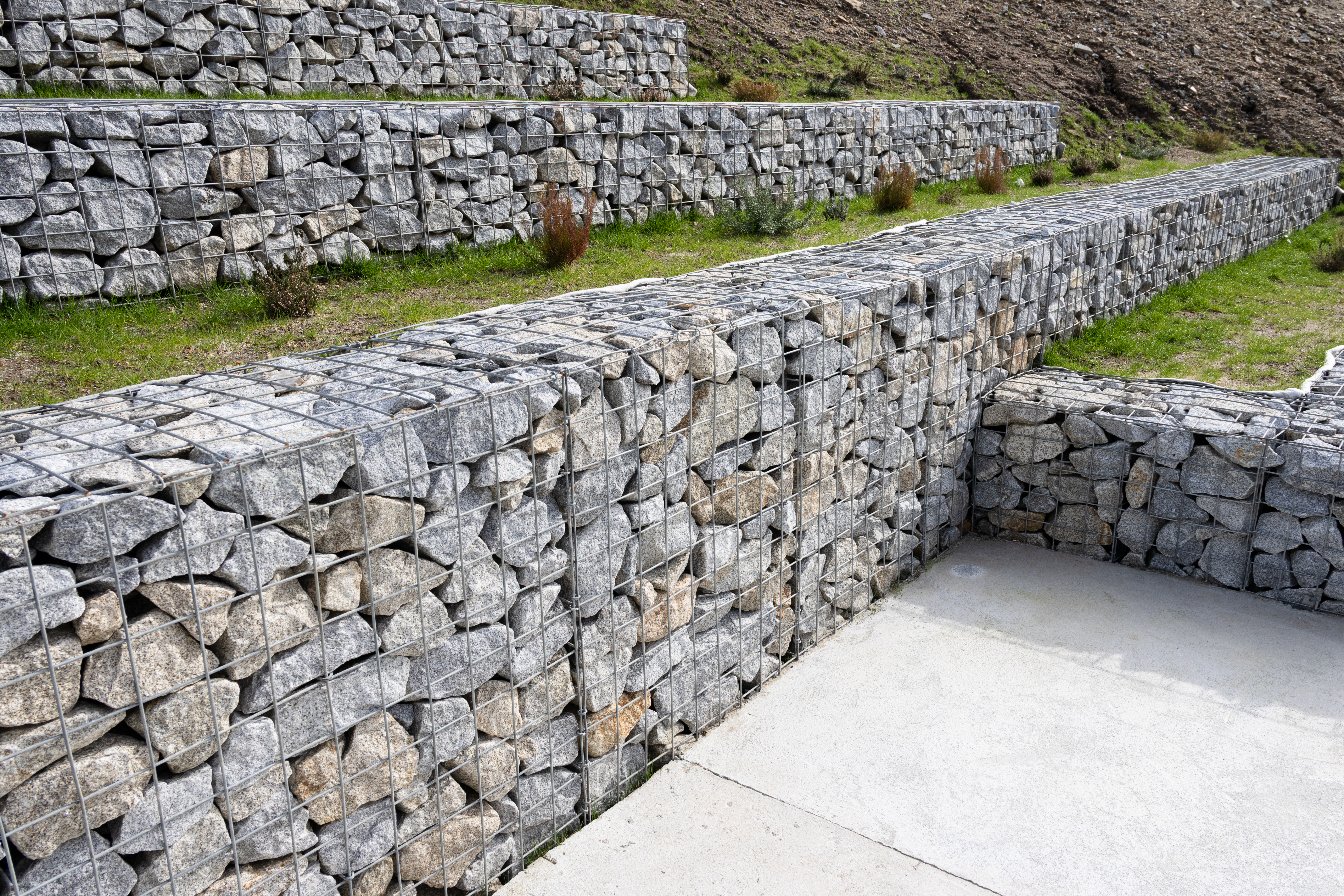
Natural stone — fieldstone, limestone, granite — is a different story. Dry-laid stone walls have natural gaps that allow water to pass through, which actually works in their favor in heavy-rain climates like ours. The tradeoff is that dry-laid stone requires a skilled hand to place correctly, and North Carolina’s licensing standards prohibit dry-laid stone walls higher than three feet above grade for good reason. Mortar-set stone walls can go taller but need proper drainage provisions just like block.
Railroad ties and pressure-treated timber are the most climate-sensitive choice in this region. Our humid subtropical summers accelerate wood decay, and even pressure-treated lumber rated for ground contact will show its age faster here than it would in a drier market. For low-height walls under two feet in informal settings, treated timber can work fine. For anything structural or permanent, it’s worth thinking longer term.
Boulders — large-format fieldstone or granite — behave differently from all of the above. Their mass does the work. There’s no mortar, no interlocking system, no engineered connection. Gravity holds them in place, and when they’re placed correctly on a stable base, they’re essentially maintenance-free. They’re not the right fit for every yard, but for naturalistic landscapes or large-scale erosion control on rural-feeling properties, nothing else comes close aesthetically.
How to Choose the Right Retaining Wall Material for Your Specific Yard
The honest answer is that there’s no single best material — there’s only the best material for your situation. A few questions help narrow it down quickly.
How tall does the wall need to be? Under two feet, almost anything works. Between two and five feet, concrete block or natural stone are both strong choices depending on budget and aesthetic goals. Over five feet, you’re in engineering territory regardless of material — North Carolina’s building code requires a licensed design professional for retaining systems with more than five feet of cumulative vertical relief within 50 feet. That’s a real requirement, not a technicality, and it affects both material choice and project cost.
What does your yard look like? If you’re in a newer subdivision in Huntersville, Cornelius, or south Mecklenburg where the homes have clean lines and modern landscaping, concrete block in a contemporary profile often looks intentional and sharp. If you’re in an older neighborhood with mature trees and a more naturalistic feel — think the rolling properties in Waxhaw or the wooded lots common around Monroe — natural stone or boulders tend to blend in better and feel more like they belong there.
What’s your budget and how long do you want this to last? Concrete block is generally the most cost-effective option per square foot for mid-height walls. Natural stone costs more upfront but can last 40 to 100 years when installed properly. Railroad ties carry a shorter lifespan in this climate. Boulders vary widely depending on stone type and site access, but once they’re in, they’re essentially permanent.
One thing worth saying plainly: the installation quality matters more than the material choice in almost every scenario. A well-drained concrete block wall will outlast a poorly drained natural stone wall every time. The material sets the ceiling — the installation determines whether you reach it.
Want live answers?
Connect with a Union Landscaping and Hardscape expert for fast, friendly support.
Natural Stone Retaining Wall Options for Mecklenburg County Yards
Natural stone has an appeal that’s hard to replicate. There’s a reason homeowners in Myers Park, Dilworth, and the lakefront communities around Cornelius consistently choose it for premium projects — it looks like it grew out of the landscape rather than being placed on top of it.
The most common natural stone options in this region are limestone, fieldstone, and granite. Each has a different character. Limestone tends to have a clean, uniform look that works well in more formal settings. Fieldstone is irregular and rustic, better suited to naturalistic designs. Granite is dense, durable, and weathers slowly — it’s a strong choice for walls that need to perform structurally while still looking refined.
Installed costs for natural stone typically run higher than concrete block, and labor costs are elevated because proper placement takes more time and skill. But for the right project, the investment makes sense — especially when you factor in the longevity and the effect on property value. We use native North Carolina stone in our natural stone installations. That’s not just an aesthetic preference. Local stone is quarried from the same geological region it’s being installed in, which means it weathers predictably in local conditions and looks genuinely at home in a Piedmont landscape.

Natural Stone vs. Concrete Block: Which One Actually Lasts Longer?
This is one of the most common questions we hear, and the answer is more nuanced than most people expect. Natural stone walls — when properly installed — can last anywhere from 40 to 100 years depending on the stone type and how well drainage was handled. Granite and quartzite sit at the longer end of that range. Limestone, while beautiful, is softer and more susceptible to weathering in acidic soil conditions, which are common in the Piedmont.
Concrete block walls, when installed with proper drainage and a compacted granular base, routinely last 20 to 40 years with minimal maintenance. The blocks themselves don’t rot, rust, or absorb water the way wood does, and they’re not affected by the mild freeze-thaw cycles we see in Mecklenburg County winters. The weak point in any block wall is almost always the drainage — not the block itself.
So which lasts longer? On paper, high-quality natural stone has the edge in raw longevity. In practice, a concrete block wall with excellent drainage will outlast a natural stone wall with poor drainage by decades. The installation — specifically how well water is managed behind the wall — is the variable that matters most in both cases.
Boulder Retaining Walls and Retaining Wall Railroad Ties: When Do They Actually Make Sense?
Boulder retaining walls tend to get overlooked in favor of block and stone, but they deserve serious consideration for the right project. Large-format boulders — fieldstone, granite, quartzite — work as gravity walls. There’s no mortar, no engineered connection, no drainage pipe required in many low-height applications. The sheer mass of the stone holds the slope. When placed correctly on a stable base, they’re virtually maintenance-free and genuinely beautiful in naturalistic settings.
They work especially well for larger properties with informal landscapes, rural-feel lots, or situations where you want erosion control that blends into the terrain rather than standing out from it. If you have a significant grade change and you want it to look like the land was always that way, boulders are often the most honest solution. The tradeoff is that placement requires equipment and experience — these aren’t materials you stack by hand.
Retaining wall railroad ties are a different conversation. They’re a legitimate option for low-height, informal applications — a two-foot garden border, a terraced planting bed, a small slope in a side yard. The key word in North Carolina is treatment. Only pressure-treated lumber rated for ground contact should be used in this climate. Our summers are hot and humid, and untreated or under-treated wood will begin to decay within a few years. Even properly treated railroad ties have a realistic lifespan of 10 to 20 years in this region, which is worth factoring into your decision if you’re thinking about long-term value.
For anything structural, anything over two feet tall, or any wall that needs to look sharp for the next few decades, railroad ties are rarely the right answer. But for the right application — a small informal project where budget is the primary constraint — they can do the job if the material spec is correct.
Which Retaining Wall Is Right for Your Mecklenburg County Yard?
If there’s one thing this guide should leave you with, it’s this: the material matters, but the installation matters more. Concrete block, natural stone, boulders, railroad ties — every one of these can succeed or fail depending on how well drainage was handled, how solid the base is, and whether the contractor understood the soil they were working with.
In Mecklenburg County, that means accounting for red clay soil, heavy summer rainfall, and the specific demands of a Piedmont slope. Those aren’t small details — they’re the difference between a wall that holds for 30 years and one that leans by year three.
If you’re ready to talk through what makes sense for your specific yard, we’re based right here in Monroe, NC and work throughout the greater Charlotte area. We’re happy to take a look at your space and give you a straight answer — no pressure, no guesswork.